
Seeing Like a Scholar: JNU’s Caves, Lived Knowledge, and the Limits of Institutional Vision
An in-depth exploration of JNU’s caves, lived knowledge, and how institutional vision limits scholarly and student experiences.
INSIGHTS
Monir Hussain
12/13/20254 min read
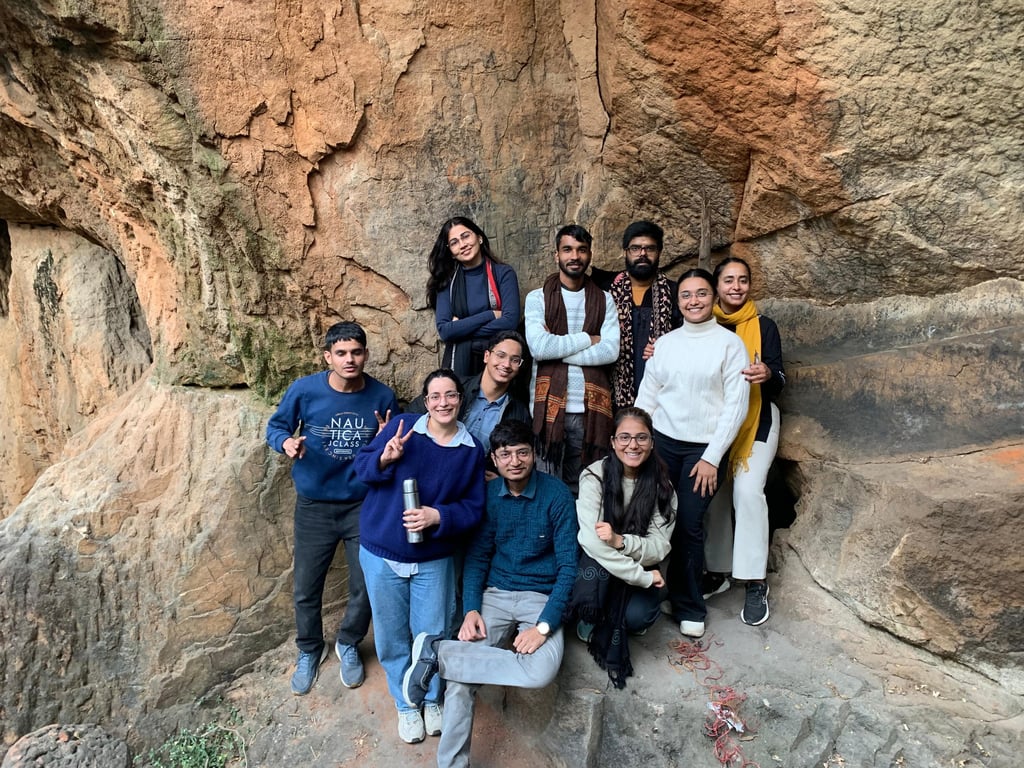
It was a mid-December evening when we, the first-semester PhD scholars from the Centre for the Study of Law and Governance, decided to step outside the classroom and into the forested ridge behind our university. Our destination: the “JNU caves”, a loosely defined term passed down through student batches, never formally mapped, rarely mentioned in institutional narratives. There was no signage, no route description, no official trail. We relied on shared memories, scattered references, and an unreliable map. And yet, despite their apparent obscurity, everyone seemed to know someone who had been.
What began as a late-afternoon walk became something else entirely. As we made our way through lantana thickets and along dusty paths worn by time, we found ourselves not just exploring a location, but stepping into a history of place, of presence, and of knowledge carried forward not by institutions, but by those who move quietly through them.
The Land Before the Map
JNU’s campus sits atop a segment of the Delhi Ridge, part of the Aravalli Range, one of the oldest geological formations on Earth. The rock was formed over billions of years ago. Shaped into rounded “tor” structures by time and weather, this grey stone carries more than geological weight. It holds traces of life.
Archaeological studies reveal that the JNU ridge has Palaeolithic microlith scatters, stone tools made by early humans who understood this terrain deeply. These tools were not left randomly. They cluster around specific formations, near water catchments and vantage points, evidence of deliberate, repeated return. Later, in medieval times, herders carved cupules into the rock—simple depressions that may have once served as game boards, a way to pass time while watching animals. These marks, incidental, remind us that people have read this land long before it was fenced and named.
And yet today, none of this appears in the institute’s official plans. There is rare conservation status, no mapped record, no mention in orientation brochures. The caves, despite being walked, sat in, studied informally, photographed, and passed through by generations of students, remain illegible to the very institution built around them.
What Is Seen and What Is Not
James C. Scott, in Seeing Like a State (1998), describes how modern institutions try to make complex realities “legible”, to reduce dense, lived, and local knowledge into simplified formats: grids, maps, categories, statistics. These simplifications are not neutral. They determine what can be seen, and therefore, what can be governed.
But what happens to what lies outside the grid?
As we approached the caves, arriving just as daylight dimmed and shadows stretched, it was striking how little of the space had been mediated by institutional vision. There were no boards, no railings, no curated narratives. And yet, there was knowledge everywhere. Peers pointed out loose rocks to avoid, shared stories of earlier visits, and marked visual cues (“take the left where the trail splits near the twisted tree”) that were unintelligible unless one had already walked the path.
This was not the kind of knowledge held in reports. It was lived. It had been learned through repetition, passed on through informal channels, and held in memory rather than documentation. It is what Scott calls metis, the practical, adaptive intelligence born from experience and context. It thrives where institutional systems recede.
Living with the Unmapped
The caves, in that sense, are not just physical features. They are a lesson in how people engage with spaces that institutions overlook. They reveal the presence of a parallel knowledge system, not one that resists authority outright, but one that endures quietly where official systems do not reach.
This became clear as we sat inside the formation, part shelter, part lookout, part amphitheater. It was not merely a place to rest. For many of us, it sparked reflection. What else have we walked past on this campus without knowing? What other forms of history or ecology live in the margins of institutional vision?
The ridge, after all, is not just forest. It is home to remarkable biodiversity: blue bulls, porcupines, jackals, peacocks, and hundreds of bird and butterfly species. But such ecological richness rarely appears in the foreground of university planning. Development proposals and infrastructure projects treat the land as blank space, rather than as a textured ecology with memory and function.
Walking as Wayfinding
There was something almost ritualistic about the way we navigated the trail, pausing at forks, waiting for slower climbers, calling out where to step. In hindsight, the walk itself was as instructive as the caves. It made visible the shared, horizontal structure of knowledge. No one was “in charge,” yet we found our way. No formal training had prepared us, but we knew enough, collectively, adaptively, moment by moment.
Scott warns that when governance ignores metis, it risks undermining the very systems that sustain it. Our experience reinforced that insight. The caves exist, are visited, and remembered not because they are preserved by institutional effort, but because they are carried in the everyday movements and memory of those who inhabit the space.
A Different Way of Seeing
What would it mean, then, for institutions to acknowledge what they do not always see? Not to fully incorporate informal knowledge into formal systems, Scott reminds us that doing so strips it of its flexibility, but to make room for it. To allow spaces to remain open-ended, lightly tended, informally known.
For JNU, this might mean modest gestures: mapping such places with care, not control; supporting student-led ecological walks; encouraging interdisciplinary research that treats the ridge not as backdrop but as archive. It might also mean asking different questions: What knowledge circulates unofficially here? What histories do not make it into the prospectus, yet shape daily life?
That December evening, as we descended from the ridge, the light was nearly gone. We moved more slowly now, feeling our way down. Phones lit up the trail, but only faintly. And yet, we were not lost. We had each other. We had the path, however narrow. And we had the quiet understanding that some things are found not by searching with coordinates, but by walking with care.
The lesson, then, is this: not everything worth knowing is in the plan. Some of it is in the walk itself.
References
Scott, J. C. (1998). Seeing like a state: How certain schemes to improve the human condition have failed. Yale University Press.Trivedi, M. (2021, February 28). What lies beneath the JNU campus in Delhi. The Print.