
Book Review : Woman at Point Zero: A Voice from the Margins of Power and Patriarchy by Nawal El Saadawi
The book exposes the harsh realities of patriarchy, sexual violence, class inequality, and state control with striking honesty. At the same time, the novel does more than provoke sympathy or outrage; it also invites readers to think critically about how oppression is represented and whether such a bleak portrayal leaves room for social coexistence or change.
BOOK REVIEW
Abu Sayed Ansari (Research Scholar, JNU)
1/28/20265 min read
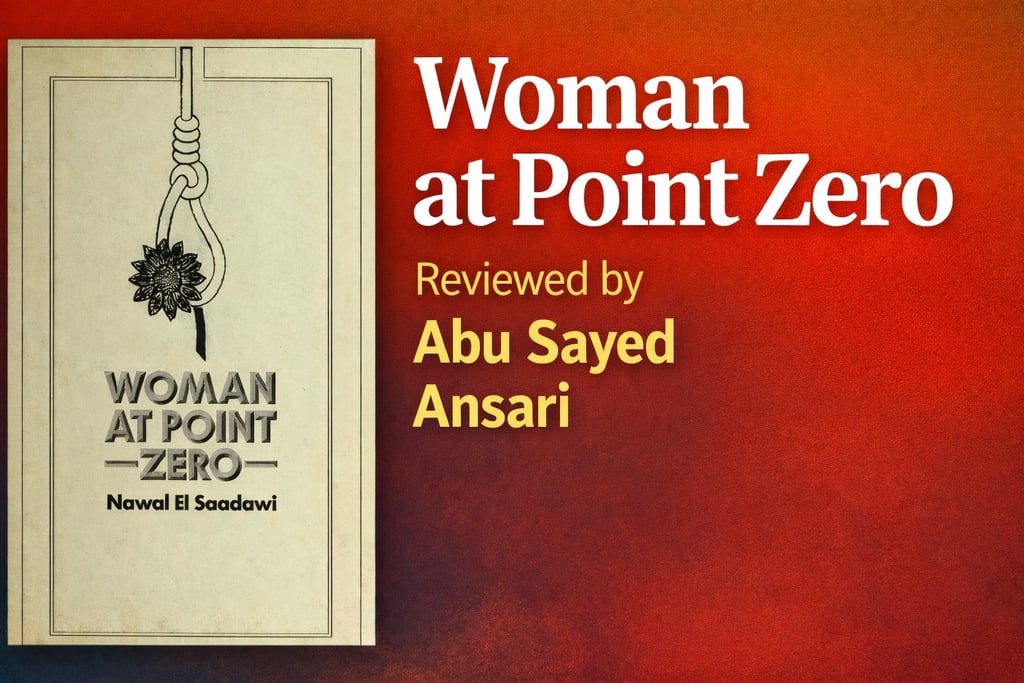
Nawal El Saadawi’s Woman at Point Zero, first published in Arabic in 1975, is a powerful feminist novel rooted in the author’s real encounter with a woman awaiting execution in an Egyptian prison. By blending personal testimony with fiction and social critique, the book exposes the harsh realities of patriarchy, sexual violence, class inequality, and state control with striking honesty. At the same time, the novel does more than provoke sympathy or outrage; it also invites readers to think critically about how oppression is represented and whether such a bleak portrayal leaves room for social coexistence or change. A careful reading, therefore, requires recognising both the novel’s emotional force and its deeper tensions, appreciating its courage in exposing injustice while also reflecting on the questions it leaves unresolved.
The Narrative Arc of Firdaus’s Life
The novel opens with Nawal El Saadawi appearing as a psychiatrist who visits a women’s prison to study the lives of female inmates. During this visit, she meets Firdaus, a woman sentenced to death for killing a man. Firdaus refuses to speak at first, setting herself apart from the others. Only on the night before her execution does she agree to tell her story, and it is this moment that gives shape to the entire narrative.
From then on, the story unfolds in Firdaus’s own words. She speaks of a life shaped by poverty, abuse, and betrayal, moving from a difficult childhood to a future that steadily closes in on her. Men control almost every stage of her life—as family members, husbands, employers, and authority figures—leaving her with little freedom or choice. Ironically, she finds a brief sense of control when she becomes a prostitute, as it allows her to earn and decide for herself, but even this freedom is short-lived and ends with the act that leads her to death row.
Patriarchy as a System of Power
The novel makes it clear that patriarchy is not just the result of cruel individuals but a system held together by family, culture, religion, economic dependence, and the law. Violence against women is treated as normal and even justified: harmful practices are defended as tradition, abuse within marriage is seen as a right, and harassment at work is brushed aside as ordinary male behaviour. Instead of challenging these wrongs, the state supports them by punishing women who refuse to submit. Firdaus’s execution brings this reality into sharp focus, showing that she is condemned not only for killing a man, but for defying a social order that demands obedience rather than justice.
The Female Body and Sexual Control
The novel places the female body at the centre of its critique. Firdaus’s body is controlled, violated, and disciplined from childhood onward. Sexuality becomes a primary site through which power is exercised.
El Saadawi challenges dominant moral narratives by exposing their hypocrisy. Marriage, often presented as respectable and protective, emerges as one of the most violent institutions in Firdaus’s life. Prostitution, commonly condemned as immoral, paradoxically offers her dignity and economic control. Through this reversal, the novel questions who defines morality and in whose interest it operates.
Class, Labour, and Economic Dependence
In Woman at Point Zero, gender oppression cannot be separated from class, as Firdaus’s poverty deepens her suffering and limits her choices at every stage of life. Her work—inside the home, in offices, or through her body—is always controlled by others and rarely respected or fairly rewarded. El Saadawi shows how economic dependence keeps women trapped in violent and degrading relationships, even when their work appears respectable. Jobs that promise security often hide exploitation behind rules and routines, while prostitution, though openly condemned, exposes this exploitation more clearly and allows Firdaus a limited ability to negotiate her own worth.
Voice, Silence, and Resistance
One of the most powerful aspects of the novel is the choice to let Firdaus tell her own story. Speaking about her life becomes an act of resistance, as it allows her to claim control over experiences that were shaped by others’ power and violence. Her refusal to ask for pardon before her execution is especially striking, as it exposes the hollowness of a system that offers mercy without respect or justice. In this final moment, Firdaus’s silence is not weakness but a deliberate and dignified act of defiance.
A Critical Question: Representation and Social Possibility
Despite its powerful critique, the novel raises an uneasy question: why are men portrayed almost entirely as cruel, violent, or morally hollow? Nearly every male character appears as an agent of control, with little room for care, responsibility, or solidarity. This creates a sense of overgeneralisation, as it presents a world where oppression seems to flow only from individual cruelty rather than from wider systems of power. From a sociological point of view, domination survives not because all individuals are immoral, but because institutions reward certain behaviours and suppress resistance. By turning men mainly into symbols of oppression, the novel risks narrowing attention away from these structural forces and toward a more absolute moral judgment.
At the same time, this limitation must be understood within Firdaus’s social position. Her story comes from extreme marginalisation, where every encounter with men is shaped by unequal power and violence. The absence of humane male figures may reflect not universal reality, but how patriarchy looks from the very bottom of society. In this sense, El Saadawi values symbolic truth over social balance, using male characters to expose injustice rather than to imagine cooperation or reform. While the novel succeeds as a fierce critique, it leaves open an important question about whether resistance based only on negation can also point toward a more just and shared future.
Strengths of the Book
The novel’s greatest strength lies in its fearless honesty. El Saadawi addresses taboo subjects, sexual violence, religion, prostitution, and state power without compromise. The prose is restrained yet devastating, allowing the weight of experience to speak for itself.
The book also succeeds in linking personal suffering with structural injustice. Firdaus is not an exception; she is a product of social arrangements. In this sense, the novel exemplifies the feminist principle that the personal is political.
Limitations
The novel offers limited psychological complexity in characterisation, especially regarding male figures. Its vision of resistance remains individual rather than collective. Readers seeking pathways for reform may find the narrative bleak.
Contemporary Relevance
Despite these limitations, Woman at Point Zero remains deeply relevant. Issues of gender-based violence, moral policing, economic precarity, and state punishment continue to shape women’s lives across societies. Firdaus’s voice resonates in contemporary debates about justice, dignity, and autonomy.
Conclusion
Woman at Point Zero is a disturbing yet necessary novel that refuses to comfort the reader and instead demands confrontation with harsh social realities. By telling the story from the margins, Nawal El Saadawi exposes how power operates at its most brutal, especially against those with the least protection. At the same time, the novel invites thoughtful reflection, as its power lies in revealing injustice rather than offering solutions. Firdaus dies with her dignity intact, but the society that destroys her remains untouched, leaving readers with the responsibility to move beyond outrage toward imagining resistance that can also lead to change.
Abu Sayed Ansari is a Research Scholar at Jawaharlal Nehru University, New Delhi, India.
Subscribe to our newsletter
Enjoy exclusive special deals available only to our subscribers.